Geology

Geology
The 366 daily episodes in 2014 were chronological snapshots of earth history, beginning with the Precambrian in January and on to the Cenozoic in December. You can find them all in the index in the right sidebar. In 2015, the daily episodes for each month were assembled into monthly packages (link in index at right), and a few new episodes were posted from 2015-18. You may be interested in a continuation of this blog on Substack at this location. Thanks for your interest!
Showing posts with label dinosaur. Show all posts

Friday, November 28, 2014

November 28. Triceratops


Besides Tyrannosaurus rex, the iconic dinosaur of the Cretaceous is probably Triceratops – or to be specific, Triceratops horridus to give the best known species its full name. Triceratops was a contemporary in time, the very late Cretaceous, 68 to 66 million years ago, and space, the margins of the Interior Seaway in western North America, with Tyrannosaurus. Tyrannosaurs were the principal predators threatening the herbivorous Triceratops.

Triceratops, whose name means ‘three-horn-face,’ was a ceratopsian, a group that includes dozens of families. What they had in common was complex ornamentation on their skulls, ranging from ornate frills to horns to fancy spines. They also typically had beak-like mouths.

Triceratops fossils were discovered near Denver, Colorado, in 1887. Paleontologist O.C. Marsh initially misidentified the age of the rocks it was from, and thought it was a Cenozoic mammal, but within a year additional specimens and more information led him to recognize its Cretaceous age and dinosaurian nature, and he named it Triceratops.

The role of the frills and other complex ornamentation has been debated over time. Some researchers considered them to be aspects of temperature regulation, like the sail on the back of the Permian Dimetrodon, but this idea is not the favored one. Display – for defense, or for sexual competition or courtship, or all three – is I think the consensus explanation for the wide variety of distinctive appearances among ceratopsians. Support for the idea that the frills might be used in combat, either against predators like Tyrannosaurs, which are known to have fed on Triceratops, or in sexual combat, comes from the nature of the bony tissue in the frills. It’s a type that heals rapidly, helping seal wounds.

Triceratops grew to 8 or 9 meters in length, 26 to 30 feet. Its skull was among the largest of any dinosaur, or any land animal, presumably big to support the complex bony ornamentation and horns. The earliest ceratopsians appeared in the Jurassic. They had pretty minimal skull decorations, and it was not until the early part of the Late Cretaceous that the first horned, frilled ceratopsians developed. Enough specimens have been found that we now see the evolutionary process that led to Triceratops as one that took at least a couple million years, as reported by researchers at Montana State University in June 2014.

Ceratopsians comprise one of the major lineages of the dinosaurs. They’re not especially close to the Sauropods, but I’ll end this episode with a note about the Sauropods. Just recently, in 2011, the first discovery was announced of sauropod fossils from Antarctica, reported by a team of Argentinean scientists. This confirms the global distribution of the gigantic herbivorous Sauropods by Late Cretaceous time, at least. During the late Cretaceous, Antarctica was near the south pole, and except for an increasingly tenuous connection to Australia, it was isolated from the other continents. Dinosaurs truly were worldwide in their range.
—Richard I. Gibson

Links:
Sauropod in Antarctica 

Triceratops' horns developed over millions of years

Tuesday, November 25, 2014

November 25. Tyrannosaurus rex


Obviously we can’t leave the Cretaceous without at least a mention of Tyrannosaurus rex. The tyrant lizard king – that’s what the name means – only lived during a relatively brief span of geologic time, a million years from 67 to 66 million years ago, just before the end of the Cretaceous. It was one of the largest land predators of all time, at 12 meters or 40 feet in length.

Henry Fairfield Osborn described the species from specimens collected at Hell Creek, Montana, in 1902 and 1908. Since then fossils from more than 50 individuals have been found. There’s enough individual variation that there are also specimens originally assigned to other species that were reassigned to Tyrannosaurus rex after further study, but there are also other species within the overall group of tyrannosaurids.

Photo of Sue, the most complete T. rex specimen known,
in the Chicago Field Museum,
by Connie Ma, used under Creative Commons license.  
They were bipedal carnivores, and the debate continues over whether they were active predators, scavengers, or both. Most researchers today seem to agree that Tyrannosaurus rex was an opportunist that both scavenged and caught live prey. It had a really strong bite that would force its teeth – up to 12 inches long – into pretty much whatever it wanted to bite.

Another current debate is whether T. rex was warm-blooded or cold-blooded. As near as I can tell, the jury is still out on that question.

The Hell Creek Formation, the rocks in which many T. rex fossils have been found, was laid down on the margin of the Cretaceous Interior Seaway that we talked about a few days ago. The setting was one of coastal flood plains and deltas, with rivers and some swampy areas. The climate must have been subtropical or tropical and clearly supported a wide range of life. There were lush forests of angiosperms, conifers, gingkoes, and cycads. Besides the famous T. rex, the Hell Creek Formation contains mammals, birds, pterosaurs, lizards, snakes, turtles, crocodilians, and a wide range of dinosaurs large and small. The more marine sediments contain fish, plesiosaurs, ammonites, sharks and rays, and there were snails, oysters, and clams in the marine and fresh waters. Lots of life, a long, tall food chain with carnivores like Tyrannosaurus rex at or near the top.

Tyrannosaurs only represent about 4% of the dinosaur fossils in the Hell Creek. The most numerous group were the Ceratopsians, horned dinosaurs, of which the most famous member is probably Triceratops, which we’ll talk about a little more in a few days.

There is of course a vast amount of information readily available about Tyrannosaurus rex. I have links below to a video and a podcast, both with Tyrannosaur expert Dr. Thomas Holtz who is at the University of Maryland, for more information.

—Richard I. Gibson

Video: The Life and times of Tyrannosaurus rex with Thomas Holtz 

Podcast link: New understanding 


Photo of Sue, the most complete T. rex specimen known, in the Chicago Field Museum, by Connie Ma, used under Creative Commons license.    

Monday, November 17, 2014

November 17. Onithopods


Hypsilophodon drawing by ArthurWesaley,
used under Creative Commons license
. 
The ornithopods were some of the most successful and diverse dinosaurs of the Cretaceous. They typically had three toes, but some had four, and despite the name, which means “bird foot,” ornithopods were not in the dinosaur lineage that led to birds. Like many types of dinosaur, they began during the Jurassic, but in Cretaceous time herbivorous ornithopods dominated many landscapes. They were typically smaller than the huge Sauropods, on the order of three to ten feet long, though a few species grew to perhaps 50 feet in length. 

Hypsilophodon, discovered on the Isle of Wight in England in 1849, was about 2 meters or 6 feet long and ran on two legs as most ornithopods did, although they probably functioned as quadrupeds at times. Its skeletal anatomy indicates that it was a ground-living animal that could probably run pretty fast – presumably for defensive escape, like a deer or gazelle, since it was a plant-eater. Because of their herbivorous natures, many Cretaceous ornithopods had lost most of their front teeth, which were replaced by a hard, beak-like mouth structure.   

Hadrosaur photo by Lisa Andres from Riverside, USA,
used under Creative Commons license
.
The culmination of evolution among the ornithopods and their kin was probably the hadrosaurs – the duck-billed dinosaurs that were abundant in late Cretaceous time. Some hadrosaurs really did have a face that was elongated into a bill-like structure presumably used for snagging leaves and twigs, but they did have grinding teeth in the back of the mouth. Duck-billed dinosaurs also had complex crests on the tops of their heads – at least some species did, but some had no ornamentation at all. The role in life of the hollow crests has been discussed for years, and I think today the consensus is that they may have been used for both audible hooting and as a visual display.

Hadrosaurs probably descended from Iguanodons or their relatives, which we discussed earlier this month. They lived in what are now Asia, Europe, and North America and are dated mostly to the last 10 or 15 million years of the Cretaceous period. All went extinct at the end of the Cretaceous.
—Richard I. Gibson

Reference: Holtz, Thomas R. Jr. (2012) Dinosaurs: The Most Complete, Up-to-Date Encyclopedia for Dinosaur Lovers of All Ages

Hypsilophodon drawing by ArthurWesaley, used under Creative Commons license. 

Hadrosaur photo by Lisa Andres from Riverside, USA, used under Creative Commons license.

Thursday, November 6, 2014

November 6. Iguanodon


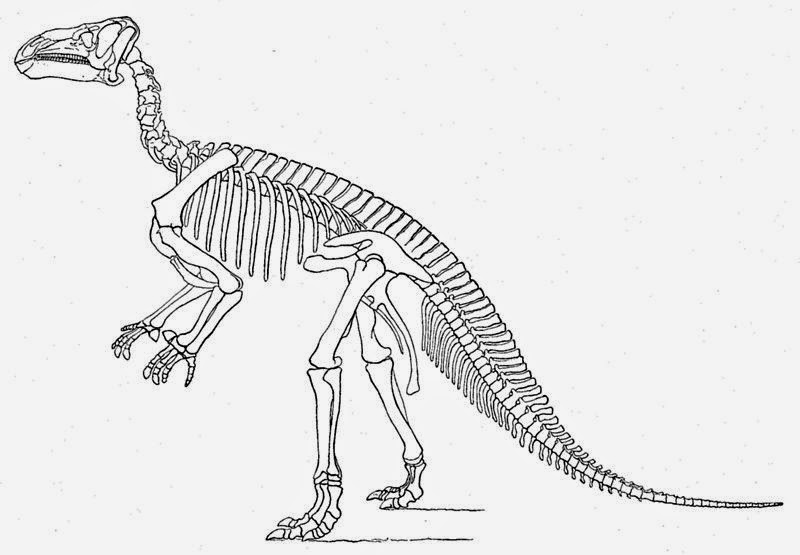
Reconstruction of skeleton by Marsh (public domain)
Iguanodon was one of the dinosaurs originally used by paleontologist Richard Owen back in the 1840s to define the Dinosauria. They were found in the Lower Cretaceous rocks of Belgium. Iguanodon probably descended from bipedal herbivores a couple meters long that date to the late Jurassic. Iguanodons grew to ten or 12 meters, about 35 feet long, and they too were bipedal herbivores, but their arms or front feet were strong enough for them to operate as quadrupeds as well. They are probably ancestral to the duck-billed hadrosaurs that became common in late Cretaceous time.

Iguanodon has had a checkered history. The first fossils, described in 1825, have since been reassigned to a different genus, and technically there is only one species in the genus Iguanodon. Subsequent fossil discoveries included some nearly complete specimens, so its anatomy can be analyzed with confidence. In 1878, at least 38 iguanodon individuals were found in a coal mine at Bernissart, Belgium, a town that gives its name to the sole iguanodon species. Their presence in the coal beds initially created considerable confusion, because the coals were Carboniferous in age. Dinosaurs were definitely anomalous in Carboniferous rocks, so what was up? Careful mapping of the rocks in the coal mine revealed the presence of an ancient 300-foot ravine, a channel cut into the Carboniferous beds. The interpretation is that a herd of grazing iguanodons stampeded over the edge of the ravine, falling to their deaths surrounded by cliffs of Carboniferous coal. If you want to imagine that they were being chased by some big carnivorous predator, you can. The ravine was later filled in with Cretaceous sediments, and it was recognized that the fossils were actually within those age-appropriate rocks rather than in the Carboniferous coal.

Thumb claw photo by en:user:Ballista,
used under Creative Commons license
Iguanodon’s hand had a long, sharp thumb-like spike, which may have been used for defense or for cracking big seeds – it was a herbivore. Its teeth – the name means “iguana tooth” – confirm its herbivorous nature. They were abundant at least locally in northern Europe and Britain, but iguanodons existed for only a geologically short period of time –around a million years or so – at about 125 million years ago, at the boundary between the Barremian and Aptian stages of the early Cretaceous.  
—Richard I. Gibson

Reconstruction of skeleton by Marsh (public domain)

Thumb claw photo by en:user:Ballista, used under Creative Commons license

Thursday, October 30, 2014

October 30. A big predator


Where there are herbivores, there are carnivores. The gigantic Sauropods of the Jurassic must have been a feast for the gigantic carnivorous dinosaurs – whether they killed them or scavenged on dead bodies. Just this year, 2014, a new species of predatory dinosaur was described from Europe, and it may be the largest Jurassic predator known.  

Torvosaurus in Museum of Ancient Life in Lehi, Utah, U.S.A.
Photo by leon7 used under Creative Commons license 
Portugal has late Jurassic rocks containing many of the same dinosaur species found in the Morrison Formation of the western United States. The Jurassic Lourinhã Formation was laid down in a flat coastal plain along the shore of the newly formed Atlantic Ocean. Rifting here began in the Triassic, as Iberia began to pull away from Newfoundland. The rift that ultimately became the Atlantic Ocean was established a bit to the west, so this area remained a low-lying zone near the margin of the ocean. The setting was much like that of the Morrison Formation, although the Morrison was along the shores of an inland sea, while the Portuguese rocks formed along a real ocean coastline. 

In both the Morrison and in Portugal, the top predator was a dinosaur of the genus Torvosaurus – a carnivore that at a glance looks a lot like Tyrannosaurus, which is a Cretaceous dinosaur. Torvosaurus was about 10 meters, 33 feet, long, and bipedal. Despite all the exploration in the Morrison formation, it wasn’t until 1971 that the first Torvosaurus specimens were found in Colorado. The Portuguese specimens, discovered in 2000, have just this year been described as the second species within the genus Torvosaurus. The differences with the Morrison species are not huge, and the species are differentiated on the basis of the number of teeth and the shape of the mouth.

The Portuguese rocks have also yielded eggs and embryos that are ascribed to Torvosaurus. The specimens are the oldest theropod dinosaur eggs with a single layer to the shell.

The Portuguese specimen is the largest land carnivore known in Europe, and among the largest Jurassic carnivores anywhere. Other carnivores shared its ecosystem, including Allosaurus and Ceratosaurus.
—Richard I. Gibson
LINKS:
Largest predator in Europe 
Torvosaurus 

Lourinhã Formation 

Torvosaurus in Museum of Ancient Life at Thanksgiving Point in Lehi, Utah, U.S.A. Photo by leon7 used under Creative Commons license 

Saturday, October 25, 2014

October 25. Sauropods


Diplodocus painting by C.R. Knight (1911)
Sauropods are another well-known group of dinosaurs that became gigantic during the Jurassic. Sauropods include such famous dinosaurs as diplodocus, brachiosaurus, and Apatosaurus. For many years, one of the most popular Sauropods was the brontosaurus, but that name was a result of the “bone wars” between paleontologists Marsh and Cope, in the 1870s. It turns out the bones used to define brontosaurus were from a juvenile variety of Apatosaurus, and the Apatosaurus name had seniority. Marsh’s huge reconstruction of a brontosaurus at the Yale Peabody Museum popularized the animal in the public consciousness, but that reconstruction used a Camarasaurus head. So today, there’s no such thing as a brontosaurus. 

But the real Sauropods were huge, with long necks and long tails balancing a big, oval body. They are almost certainly the largest animals ever to live on land, and their only competition in terms of size are aquatic mammals like the blue whale. Diplodocus, a common Jurassic sauropod, was up to 170 feet long, and some brachiosaurs were as much as 60 feet tall, four times the height of a modern giraffe. The smallest Sauropods were around 20 feet long.  Many of the most famous specimens of Sauropods came from the Jurassic Morrison Formation of western United States, especially in Colorado, Wyoming, and Utah, where Marsh and Cope worked in the 1870s and 1880s. 

In contrast to early depictions that indicated these animals were so big they had to live in water to be supported, the modern interpretation is that Sauropods certainly walked on dry land. Or not-so-dry land: the environment of the Morrison Formation was wet mud flats and river flood plains, and sauropod footprints show that they lived in such areas as well as wet, coastal environments.

Although Sauropods appeared in the late Triassic, they diversified and grew to gigantic sizes throughout the Jurassic and into the Cretaceous. By Jurassic time they were widespread. Even though few complete, or even reasonably complete fossils are known, their bones are common enough that we know Sauropods were present on every continent, including Antarctica.

Sauropods appear to have been herd animals that traveled in groups segregated according to age. That fact can be interpreted to suggest that they did not exhibit much parental behavior, and that juveniles quickly began to flock together, but some fossil assemblages include mixtures of individuals of different ages, which could mean there was some parental care for the young. Some of the oldest fossil eggs with well preserved embryos, from the early Jurassic of South Africa, are from prosauropods that are probably an ancestral or sister group to the Sauropods. They’ve been interpreted to suggest that the animals crawled on four feet before learning to walk and rear up on two legs. Sauropods were not bipedal, but they probably could lift themselves on their hind legs to reach high into trees to get at leafy vegetation there. 

You might expect sauropods’ feet to be something like those of modern elephants, but that’s not correct. Their front feet did not splay, like elephants’, but in many species were almost a stiff bony column with the digits reduced to near-invisibility. Big stumps, more or less. The hind feed did have claws, and I think that’s the basis for the name, which means “lizard-foot.”

As you can imagine, there’s a vast literature on sauropod dinosaurs and a lot of it is readily available online. What I’ve given here is just a basic outline.
—Richard I. Gibson

Brontosaurus story
Prosauropod eggs and embryos 
Painting of diplodocus rearing, by Charles R. Knight, 1911 (public domain via Wikipedia)

Tuesday, October 21, 2014

October 21. Stegosaurus


Drawing by Marsh (USGS, public domain). This is an inaccurate depiction – a single row of back plates (rather than two) and too many tail spikes (should be two pairs).


We really can’t go through the Jurassic without talking about stegosaurus, arguably one of the most recognizable dinosaurs. The first specimen of stegosaurus was found near Morrison, Colorado, in 1877, by O.C. Marsh during his “bone war” with Edward Cope. Its remarkably small brain was noticed immediately – something like 2½ ounces for a 10-ton body, and modern reconstructions depict a creature that may have moved slowly but that probably carried its spiked tail high and might have wielded it like a weapon. 

Stegosaurus, whose name means “roofed” or “covered lizard,” in reference to the bony plates on its back, was a herbivore that grew to 30 feet long. It couldn’t lift its head very high, so it probably grazed on ground cover or short bushes.

For all its fame, only about 80 individuals are represented in fossils. Most are from the Morrison Formation of western United States, but in 2006 one was found in Portugal. Ancestral stegosaurids – not the genus Stegosaurus – are known from the United States, China, England, Germany, and France, but Stegosaurus itself appears to have had a limited distribution in both time and space. There are some Cretaceous specimens that some researchers have attributed to Stegosaurus, but this is not generally accepted, and as far as we can tell with certainty, Stegosaurus was only on the scene for about 5 million years, from about 150 to 155 million years ago.

If you see an image of Stegosaurus juxtaposed with Triceratops or Tyrannosaurus rex, be very suspicious. That image is off by about 80 million years.

—Richard I. Gibson

Kung-fu Stegosaur

Drawing by Marsh (USGS, public domain). This is an inaccurate depiction – a single row of back plates (rather than two) and too many tail spikes (should be two pairs).

Friday, October 17, 2014

October 17. Ceratosaurus


Ceratosaurs were late Jurassic carnivorous dinosaurs that lived at least in western North America and in Portugal, two places where its fossils have been found. It was around 20 to 25 feet long and had a pretty typical dinosaurian shape, but with several horns on its snout and head. Its name means “horned lizard.”

The first specimens were discovered in 1884 and described by O.C. Marsh, a paleontologist who explored the western United States. He was prolific in his fossil collecting. His discovery of Ceratosaurus came in the midst of the Bone Wars – the intense competition between Marsh and Edward Drinker Cope, a personal animosity that spilled over into their professional lives. Many books address this battle, which was also a time when vast numbers of dinosaur fossils were discovered.  

Technically, Ceratosaurus is a genus of the larger group of ceratosauria, whose fossils have been found in North and South America, Europe, Africa, and Madagascar. There may be three species of Ceratosaurus, but it’s not completely agreed that that’s the case. It’s possible that some of the fossils assigned to different species, such as the ones found in Portugal, may be variations in a single species due to age or simply to individual variation.

The first known ceratosaurs date to about 225 million years ago, the late Triassic, but it was during the Jurassic that they diversified significantly. Ceratosaurus nasicornis – meaning “horned lizard with a nose horn” – was the one described by Marsh from Late Jurassic sediments, and it’s the largest ceratosaur known at 20 or more feet long.

Modern Ceratosaurus reconstruction drawing by DiBgd at en.wikipedia used under CC-BY-2.5
Ceratosaurs were theropods, a large diverse group of dinosaurs that were bipedal, though not necessarily with the upright stance that has traditionally been depicted. More likely, the body was carried more close to a horizontal position with respect to the ground. Marsh’s drawings of dozens of dinosaurs, many of them published in USGS Annual Report Volume 16 part 2, Dinosaurs of North America, showed the upright orientation, leading to reconstructions in museums that have continued that tradition. Today, better understanding of the ways the hip and leg bones worked has led to the view that they carried themselves on two legs, but more level with the ground.

Theropods include dinosaurs that had feathers, as well as all birds. Ceratosaurus was in a different branch of theropods – closer to birds than crocodilians, but not all that close.


—Richard I. Gibson

Modern reconstruction drawing by DiBgd at en.wikipedia used under CC-BY-2.5 

Ceratosaurus as a tattoo  (YouTube)

Wednesday, September 17, 2014

September 17. Dinosaurs


A week ago we talked about the archosaurs, the reptilian ancestors of dinosaurs, and I mentioned the oldest known dinosaur, Eoraptor, dated to 231 million years ago, in the late middle Triassic. By late Triassic, dinosaurs were clearly expanding both in terms of diversity and geographically. Coelophysis was a 9-foot, 100-pound carnivore that lived in southwestern North America by about 225 million years ago. Fossils similar to Coelophysis have since been found in many parts of the world, indicating it was a successful and adaptable animal that took advantage of the more-or-less connected nature of the supercontinent of Pangaea.  

Coelophysis was a theropod, meaning “animal foot,” a branch of the dinosaurs that were bipedal, with an upright stance. This group also includes birds, which descended from a dinosaur lineage.

Herbivorous dinosaurs had also evolved by late Triassic time. Plateosaurus was an exclusively bipedal animal up to 30 or so feet long, much of that in its neck. This presumably made it able to reach higher into trees and other leafy vegetation.

Plateosaurus skeleton photo by FunkMonk, under creative commons license


Dinosaurs are defined taxonomically as archosaurs with distinctive bone structures that allowed them to carry their bodies more directly above their legs. This applies to both two-legged stances and four-legged stances. The non-dinosaur crocodilians continued a more sprawling stance, with the legs extended away from the body rather than beneath it. The upright stance allowed for a speedier gait. It’s possible that the earliest dinosaurs were bipedal, and that the later 4-legged varieties actually reverted to that anatomy somewhat later.

Dinosaurs competed with other varieties of reptile and with therapsids like cynodonts. Two extinction events, one at about 215 million years ago during the late Triassic and the other at the end of the Triassic affected the primitive reptiles and therapsids more drastically than the newly evolved dinosaurs, and this may have given them more ecological niches to expand into. We’ll talk more about the extinction events at the end of the month. But that end-Triassic extinction seems to have ultimately proved beneficial to the dinosaurs, because they really began to take off after it happened.
—Richard I. Gibson

Plateosaurus skeleton photo by FunkMonk, under creative commons license.   

Wednesday, September 10, 2014

September 10. Archosaurs


So we’re in the Mesozoic, the Age of Dinosaurs. Where are they? Well, hold on – we’re still pretty early in the Triassic Period, and true dinosaurs have not yet evolved. We do have things called archosaurs – the group that includes modern birds and crocodiles, extinct dinosaurs, and the ancestors of them all. “Archosaur” means “ruling lizard,” and they were reptiles that might have evolved in the very late Permian Period, but were definitely on the scene in early Triassic time. 

Archosaur drawing by Nobu Tamura under GFDL

Archosaurs succeeded the Permian synapsids, pre-mammals including dimetrodons and cynodonts, as the dominant land vertebrates in the early Triassic. Some cynodonts survived the Permian extinction, but archosaurs seem to have been able to adapt and use the vacated ecological niches to expand and diversify after the extinction event. They may have had better systems for managing water than their synapsid cousins, and that would have been an advantage in the hot, arid climate of the early Triassic. They might also have developed a more efficient, upright walking stance that was better suited to breathing. This could have led to the earliest upright, bipedal reptiles. In reconstructions, they look a lot like skinny lizards on tall legs.

Archosaurs are the ancestors of many diverse groups. By the late part of the middle Triassic, the group we know as dinosaurs had evolved from pre-dinosaur archosaurs. One of the oldest known animals that is definitively classed as a dinosaur is Eoraptor, whose name means dawn-raptor, discovered in northwestern Argentina in 1993. It was about a meter long – three feet – and was bipedal, standing upright and scurrying across the forested floodplains where it lived. Its teeth suggest that it was an omnivore – both carnivorous and herbivorous. The rocks it was found in are dated pretty accurately at about 231 million years ago, 20 million years after the Permian extinction, and near the end of the middle Triassic.

Archosaurs evolved from cold-blooded ancestors, but some evidence suggests that they, and their dinosaur descendents, were warm-blooded. This idea remains a focus of study, since the best evidence comes from anatomical studies of things like lungs and heart, which are seldom preserved. Inferences come from muscular structure, cavities in skeletons, and such, so the evidence is indirect. But it’s pretty generally accepted today that most dinosaurs were active, warm-blooded animals. Whether their ancestral archosaurs were or not is uncertain.

* * *

Stephen Jay Gould was born September 10, 1941, in New York City. As an evolutionary paleontologist, he developed the concept of punctuated equilibrium, the idea that the history of life on earth was long periods of relative stability punctuated by occasions when rapid change took place. He was best known as one of the premier writers of popular science in the last quarter of the 20th century. Hundreds of essays and many books, including Wonderful Life, about the Cambrian Burgess Shale, fixed Gould firmly in the public eye as a popularizer of geological science.
—Richard I. Gibson

Link:
What’s an archosaur?

Drawing by Nobu Tamura under GFDL